Brand guide
How to adjust an Orient watch band
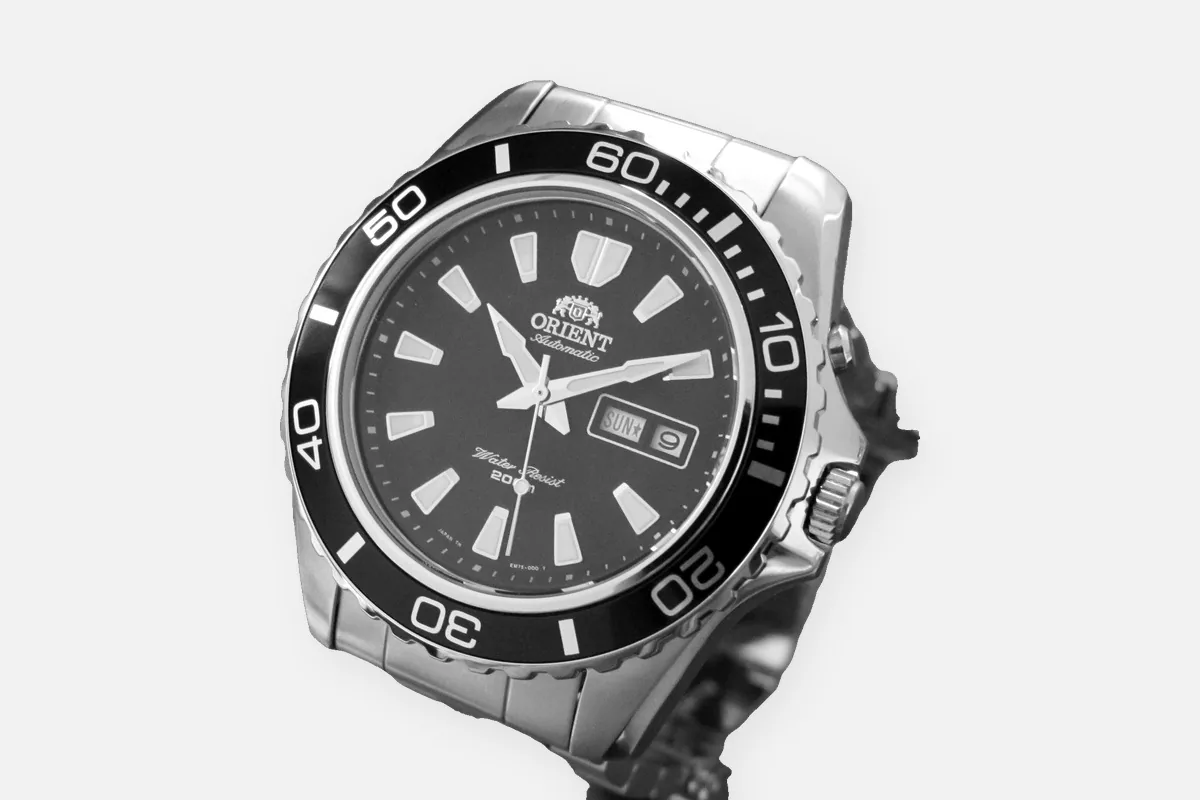
Orient sits in the same family as Seiko and behaves the same way on the bench. Orient's own guide puts it plainly: flip the bracelet over, find the arrows, push the pin out in the direction of the arrow, and tap it back in the opposite way.
What Orient adds is variety. Its guide names plain pins, pins with collars on both ends, and L-shaped pins in folded-link bracelets. The arrow rule covers them all.
Check the clasp first
Most Orient fold-over clasps have micro-adjust holes for the spring bar inside the clasp. If you are between sizes, move that spring bar one hole with the tip of a spring bar tool before you take out a whole link. Some diver clasps also have an extension. Check your model's clasp before you assume you need a link out.
Removing links step by step
- Find the arrows. Turn the bracelet over. Removable links have arrows on the inside next to the pin holes.
- Seat the link in a holder. Arrow facing down into the slot so the pin can exit.
- Push the pin with the arrow. Use a pusher that fits the pin. Steady pressure, straight in.
- Keep the collars. Orient notes collars can sit on both ends. Catch every one.
- Remove links evenly. Same number on each side of the clasp.
- Tap the pin back against the arrow. Fit collars first, join the links, then seat the pin with a small hammer until flush.
The failure to avoid
Same as Seiko: the collar drops the instant the pin is out and is nearly invisible on a workbench. Work over a tray. And never push against the arrow. The pin wedges the collar tighter, and a deformed collar no longer holds the pin reliably.
Folded-link braceletsOlder and budget Orient bracelets with folded links often use L-shaped or split pins. Push them out with the arrow and, if needed, pull them the rest of the way with flat pliers. Do not squeeze the open end of a split pin, it loses its grip.
FAQ
How do I remove links from an Orient watch?
Push the pin out in the direction of the arrow on the inside of the link, catch any collars, remove links evenly on both sides of the clasp, and tap the pin back in against the arrow.
Are Orient and Seiko bracelets the same?
They use the same basic principle, directional pins, often with collars. Orient's own guide also mentions L-shaped pins in folded-link bracelets.
Can I adjust an Orient band without removing links?
Often, for small changes. Move the spring bar inside the clasp to another micro-adjust hole, or use a diver extension if your clasp has one.