Main guide
How to adjust a watch band
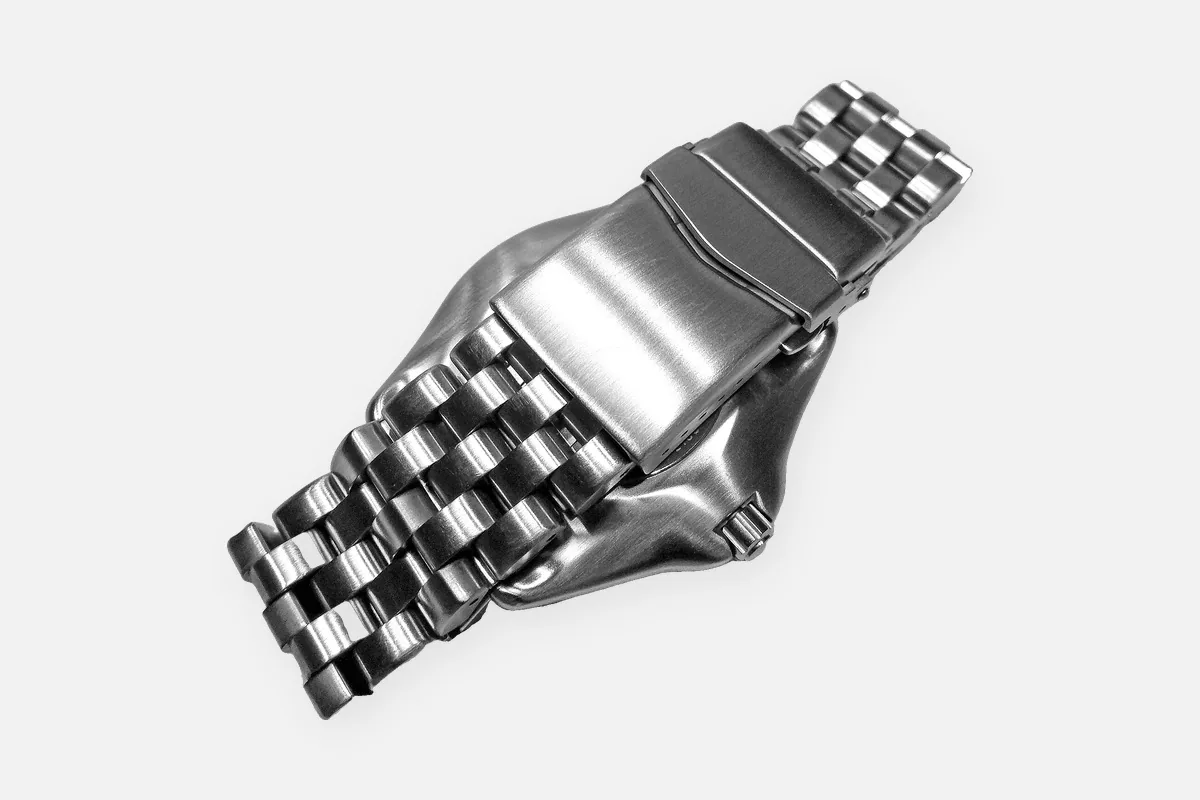
Almost every band problem is decided before you pick up a tool. Get the mechanism right and the job takes ten quiet minutes. Get it wrong and you bend a collar, strip a screw or scratch a lug in the first thirty seconds. This guide is built around one rule: identification first, tool second.
There are five systems you will meet on a wristwatch. The table below tells you which one you have. Each system then gets its own method, and the brand guides at the end cover the details each manufacturer gets wrong most often.
Identify your band in ten seconds
Turn the watch over and look at the inside of the bracelet next to the clasp.
| What you see | System | What adjusts it |
|---|---|---|
| Small stamped arrows on the inside of the links | Pins (friction, split or collared) | Push the pin out in the arrow direction |
| A slot on the side of the link | Screws | A watch screwdriver that fills the slot |
| Woven or folded band, clasp with a flip-up plate, no arrows | Mesh or slide clasp | Slide the clasp, no links to remove |
| Stretchy band | Expansion band | Depends on the type, see Timex |
| Leather, rubber, fabric with holes | Strap and buckle | The buckle holes |
How to adjust a metal watch band with pins
This is the most common system on steel bracelets, from Seiko and Citizen to Tissot, Fossil and Casio's analog models. A pin runs through the link. Sometimes a tiny split sleeve, the collar, grips it in the middle link. The arrow on the inside tells you the only direction the pin will come out.
- Count the links to remove. Put the watch on, pinch the slack and count. Plan to split them evenly across both sides of the clasp.
- Find the arrows. On most brands only links with arrows are removable. Fossil Group also uses pin and tube links without arrows. No arrow and no slot: check your brand guide before pushing anything.
- Seat the link in a holder. Arrow pointing down, the link supported on both sides of the pin.
- Push the pin out with the arrow. A pin pusher that matches the pin diameter, straight and steady.
- Catch any collar. Collared pins drop a tiny sleeve from the middle link.
- Reassemble against the arrow. Refit the collar, join the links and push the pin in against the arrow until flush. Check the fit and repeat if needed.
The full guide to removing watch links covers every pin type, the tools, and what to do when a pin will not move.
Screwed links
Common on Rolex, Omega, Tudor and many other higher-end bracelets, and on some oversized models. There are no arrows, instead you see a slot on the side of the link. It needs a watch screwdriver that fills the slot, never a pusher or hammer. The method is in how to remove screw links.
How to adjust a mesh watch band
Milanese mesh and folded steel bands, like Casio's Vintage line, have no links. The clasp slides along the band and hooks into a groove or indentation. A pin pusher does nothing here.
- Open the clasp and lay the watch face down on a soft cloth.
- Lift the locking plate inside the clasp with a fingernail or a thin flat blade in its slot.
- Slide the clasp along the band. Toward the watch head makes it tighter.
- Seat the clasp in a groove or indentation and press the plate down until it clicks.
- Pull on the band to check it holds before you wear it.
Straps with a buckle
Leather, rubber and fabric straps adjust at the buckle. A new leather strap should close on the second or third hole so there is room in both directions as it wears in. If you need a different length, change the strap. That takes a spring bar tool or, on quick-release straps, no tool at all, see how to change a watch band.
Fine adjustment in the clasp
Many fold-over clasps have two to four small holes on the side. A spring bar in the clasp sits in one of them. Moving it one hole is a smaller step than a whole link and often solves a band that is almost right. Push the spring bar end in with the fine tip of a spring bar tool, move it and let it snap into the next hole. Some diver clasps also have a slide or fold-out extension.
The four mistakes that cause almost all damage
- Improvised tools. A paperclip, sewing pin or nail slips and lands on the most visible surface of the watch.
- Pushing against the arrow. On collared pins this jams and deforms the collar so it never grips properly again.
- Treating a screw like a pin. A pusher on a screwed link strips the head and can crack the link.
- Looking for links that do not exist. Mesh, slide clasps, Apple Watch bands and most resin straps have no links to remove.
When to do it yourself and when not
A pinned steel bracelet, on a soft surface, with the right pusher and holder, is a confident home job. A screwed bracelet on an expensive watch, a titanium bracelet that marks easily, or any watch you are not willing to risk, goes to a watchmaker. Citizen, for example, recommends professional sizing. That visit usually costs less than a scratched lug.
Guides by brand
Every brand has one detail that trips people up. Pick yours:
- Apple Watch watch band guide
- Bulova watch band guide
- Casio watch band guide
- Citizen watch band guide
- Daniel Wellington watch band guide
- Fossil watch band guide
- Garmin watch band guide
- Hamilton watch band guide
- Invicta watch band guide
- Michael Kors watch band guide
- Orient watch band guide
- Seiko watch band guide
- Skagen watch band guide
- Timex watch band guide
- Tissot watch band guide
FAQ
How do I know which mechanism my watch band uses?
Turn the bracelet over. Arrows mean pins, a slot on the side of the link means screws, a woven or folded band with a flip-up clasp means mesh or slide clasp, and holes mean a buckle strap.
How do I adjust a metal watch band at home?
If the links have arrows, push the pins out in the arrow direction with a pin pusher in a holder, remove links evenly on both sides of the clasp and refit the pins against the arrow. If the links have slots, unscrew them with a fitting watch screwdriver instead.
Which watch bands adjust without tools?
Slide clasps, mesh bands, Apple Watch bands, quick-release straps and buckle straps adjust by hand. Link bracelets with pins or screws need the right tool.
How do I make my watch band smaller without removing links?
Use the micro-adjust holes in the clasp, or a slide or extension if your clasp has one. On mesh and slide clasps, move the clasp toward the watch head.
How do I adjust a mesh watch band?
Lift the locking plate inside the clasp, slide the clasp along the mesh, seat it in an indentation and press it closed. Mesh bands have no links to remove.