Tool guide
Watch link removal tool
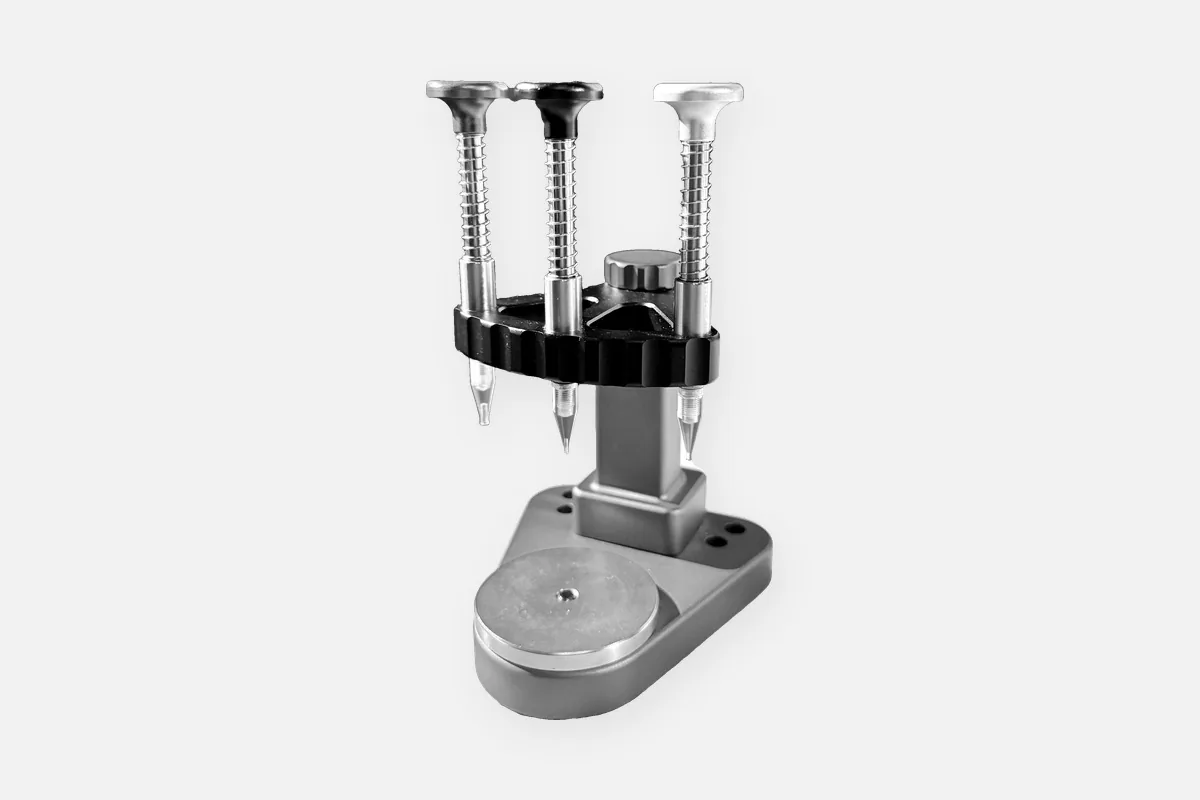
A watch link removal tool pushes the pins out of a metal bracelet so you can take links out. Before anything else: it only helps if your bracelet actually has removable pinned links. Mesh bands, slide clasps, Apple Watch bands, resin straps and screwed bracelets need something else. Confirm that first, it is the most common wasted purchase in this category.
The three types of link removal tool
| Type | How it works | Good for | Watch out for |
|---|---|---|---|
| Bench pusher (screw-driven) | The bracelet sits in a cradle, you turn a handle and a pin drives straight down | Most arrow-marked pins. The straight, controlled force protects the finish | Cheap ones have soft pins that bend. Check spare pins are included |
| Hand pusher and holder block | A pin tool pressed by hand with the link resting in a slotted block | Loose pins, collared pins with a bit of control | Slips if the block does not fit the link |
| Pin punch and hammer | Tap the pin with a punch while the link sits in a holder | Very tight pins, refitting pins flush | Never freehand. The holder is not optional |
For screwed bracelets, none of these is right. You need watch screwdrivers in fitting blade sizes, ideally two for counter-holding.
What separates a good tool from a bracelet-scarring one
- The holder. It must clamp or cradle the link without play and leave room under the pin to exit. A loose link moves under the pusher, and that is when it slips.
- The pusher pin. Hardened, and matched to the pin diameter. Many bracelets use pins around 0.8 to 1.0 mm. A pin that is too thin bends, one that is too thick jams in the hole.
- Straight force. Bench pushers win here because the pin cannot go in at an angle.
- Spares. Replacement pusher pins in two or three diameters. They are consumables.
Collars: the part that gets lost
On collared bracelets, a tiny split sleeve sits in the middle link. It falls out the instant the pin clears it. Work over a tray, use tweezers, and keep each collar with its pin. A pin that slides back in with no resistance has lost its collar.
Which one should you buy?
Checklist for any link removal tool listing
- Pusher pins in several diameters, including sizes around 0.8 and 1.0 mm, plus spares.
- Hardened steel pins, not soft or plated wire.
- A holder or cradle with slots for different link widths that lets the pin exit below.
- For bench pushers: a screw drive that lowers the pin straight, without play.
- If you have screwed bracelets: a set of watch screwdrivers with replaceable blades in several widths.
- Honest scope: no single tool fits every bracelet. Pins and screws need different tools.
For one or two pin bracelets, a solid hand pusher with a good holder block is enough. If you size bracelets regularly, or you have tight pins like the Tissot PRX, a bench pusher is worth it. If your bracelet is screwed, buy proper watch screwdrivers and skip the pusher. If your band is mesh, slide clasp or a strap, do not buy anything here.
No affiliate linksLugwork does not sell tools or earn commission on them. We describe what matters so you can judge any tool yourself.
New guides by email
An occasional email when a new guide is published. Sent via MailerLite with double opt-in, unsubscribe anytime. Details in our privacy policy.
FAQ
What is the best watch link removal tool?
For arrow-marked pins, a bench pusher with a hardened pin and a cradle that holds the link without play. For screwed links, fitting watch screwdrivers. There is no single tool for both.
Do I need a hammer to remove watch links?
Not usually. A pusher removes the pin. A small brass or nylon hammer helps seat pins flush when you reassemble, always with the link in a holder.
What size pin do I need?
Many bracelets use pins around 0.8 to 1.0 mm. A good tool comes with several pusher pins, use the largest one that fits the hole.
Can a link removal tool damage my watch?
Yes, if the pusher is soft, the wrong diameter, or used without a holder, it skids and marks the bracelet. A pusher on a screwed link strips the screw.