Tool guide
Spring bar tool and spring bars
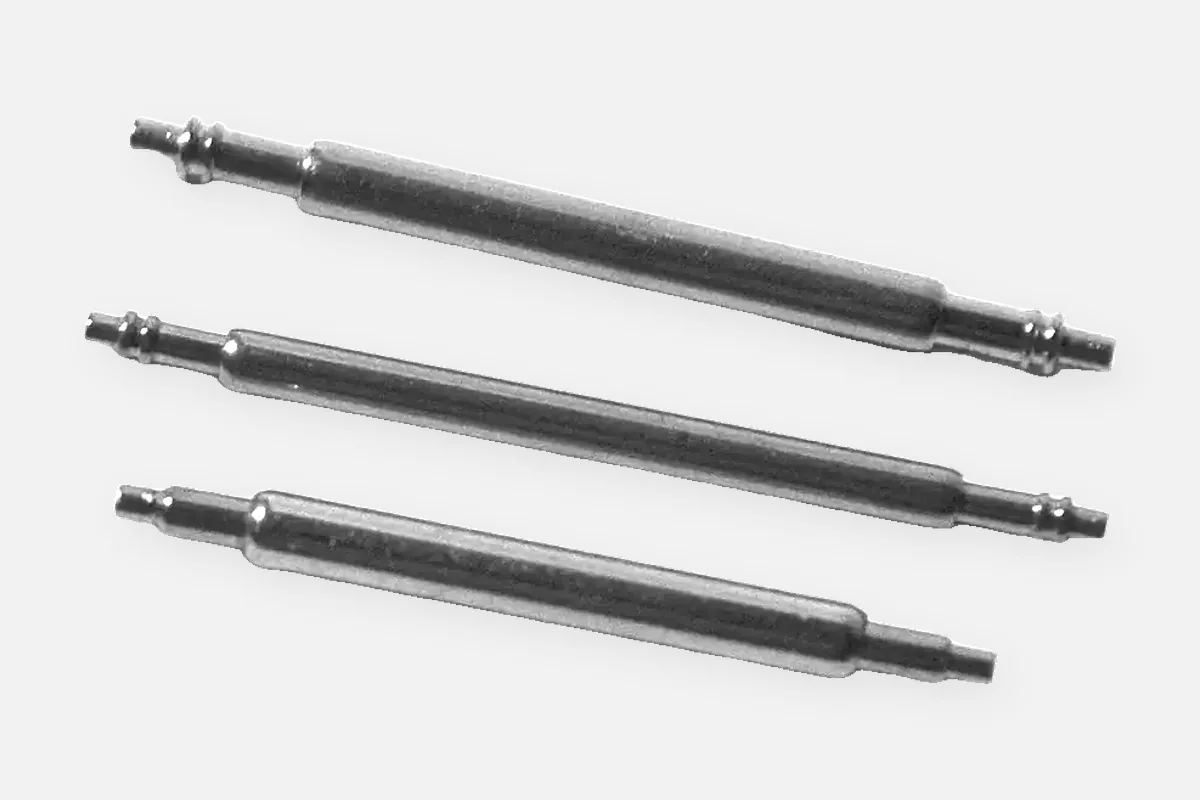
A spring bar tool does one job: it compresses the small sprung bar that holds a strap between the lugs, so the strap comes off. It is the single most useful watch tool to own, because almost every watch sits on spring bars at the lugs, even when the bracelet itself uses pins or screws.
How a spring bar tool works
A good tool has two ends. The fork slides between strap and lug, catches the shoulder of the spring bar and pushes it inward so the tip leaves the lug hole. The fine pin is for drilled lugs, where you push the bar tip in from the outside through a small hole in the lug. Many tools also accept interchangeable tips.
What matters when you choose one
- The fork tip. Thin enough to enter a tight gap, hard enough not to splay open. A splayed fork slips, and a slip lands on the side of the lug.
- A fine pin end for drilled lugs and for moving the spring bar in clasp micro-adjust holes.
- Grip and control. A handle you can hold like a pen, with the tip close to your fingers.
- Replaceable tips. Forks wear. A tool with spare tips outlives several cheap ones.
One well made spring bar tool beats a large cheap assortment. You will use it for every strap change for years.
Choosing spring bars
| Type | Used for |
|---|---|
| Double shoulder | The standard bar for straps and bracelet end links |
| Single shoulder | Clasps and fold-over buckles |
| Shoulderless | Only removable through drilled lugs |
| Quick release | A bar with a lever, needs a strap with a notch for it |
| Curved | Some bracelet end links |
The length equals your lug width, 18, 20 and 22 mm are the most common. Common diameters are 1.5, 1.8 and 2.0 mm, larger diameters for thicker straps and bigger holes. Replace old, bent or rusty bars instead of reusing them with a new strap.
What a spring bar tool will not do
It does not remove bracelet links. Pinned bracelets need a pin pusher, screwed bracelets need a screwdriver. Buying a spring bar tool expecting it to shorten a steel bracelet is one of the most common mismatches.
New guides by email
An occasional email when a new guide is published. Sent via MailerLite with double opt-in, unsubscribe anytime. Details in our privacy policy.
FAQ
How do you use a spring bar tool?
Slide the fork between strap and lug, catch the shoulder of the spring bar and push it toward the center of the strap until the tip leaves the lug hole, then lift the strap out. On drilled lugs, push the bar tip in through the hole from outside with the pin end.
What size spring bars do I need?
The length matches your lug width in millimeters. The diameter depends on the lug holes and the strap, 1.5, 1.8 and 2.0 mm are common.
Can I use a spring bar tool to remove links?
No. It only compresses spring bars. Links need a pin pusher or a screwdriver.
What should I look for in a spring bar tool?
A hardened, thin fork that does not splay, a fine pin end for drilled lugs, a controllable grip and replaceable tips.